




Public cloud in Germany | EU-Cloud
EU-Cloud is a new generation cloud located at the Data Center in Frankfurt, and designed to host complex application landscapes and high-load business-critical applications.
Frankfurt is the business capital and a real digital hub of the European Union. It houses the offices of leading corporations and various international institutions of the highest level. This is a place where reliability and manufacturability stand side by side allowing you to implement effective, convenient and most importantly safe solutions for business.
De Novo cooperates with leading Ukrainian companies that value quality, high level of technology and service. That is why Germany, namely the city of Frankfurt, was chosen as the place to build cloud infrastructure in the EU.
The EU-Cloud infrastructure is based on the VMware Validated Design for Software Defined Datacenter hyper-convergent architecture. De Novo has the VMware Cloud Verified partnership status.

Why are IaaS profitable than own infrastructure?
At first glance, the cost of acquiring equipment is lower than the same amount of resources in the cloud. But is it really so?
We decided to look into this in detail and tell you the following:
- What are the advantages and nuances of using each of the options
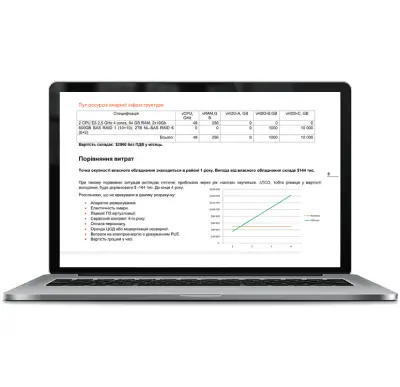
- Cloud Infrastructure Break-Even Calculation
- Comparison of costs taking into account all previously unaccounted for factors
Compare both options on real examples, taking into account all potential costs and choose what will be more effective for your business.
Why choose De Novo public cloud?

The cloud is built according to VMware reference architecture and practices

Simple DR solutions out of the box, with the ability of quick application

Cloud backup in Ukraine, Germany and additional copy in AWS S3

Large virtual machines with guaranteed availability of each individual machine

Contractual conditions in the legal field of Ukraine and fees calculated in UAH

High availability of up to 99.95% and SLA with responsibility up to 12 monthly payments

Data and processes are certified ISO27001, ISO27701, PCI DSS Level 1

24/7 Fanatic Support is available in 3 languages
Calculate the cost of a public cloud
• The price already includes IaaS-level and data center infrastructure redundancy.
• High availability is included by default.
• There are no hidden charges after deployment.
The form displays only the base configuration options.
Submit a request to receive a detailed commercial proposal tailored to your requirements.
De Novo Clouds

Physically isolated virtual infrastructure that combines the benefits of cloud technologies and on premise hardware and is provided to the customer as a service

New generation cloud for complex application landscapes and business-critical applications with a high load, located in Ukraine

Specialized cloud for pulic sector, which is KSZI certified and is located in a secure module

A new generation cloud, located in Frankfurt, Germany. Designed for complex applied landscapes and business critical applications with high workloads

Cloud designed to host HANA databases and SAP applications, and other highly loaded business-critical infrastructures

Wide range of services for flexible cloud infrastructure backup

Comprehensive solutions for cloud and local infrastructure recovery in the event of an accident

Warm migration tools offer transfer of large amounts of business-critical application data to the De Novo cloud quickly and without downtime
Where are European cloud providers’ customer data physically located?
Most infrastructure contracts begin with a simple question: Where will the data be stored? And this is less about legal formalities than about practical understanding — how far the nearest data center is, who controls it, and what kind of energy infrastructure it relies on.
Cloud providers in Europe operate within clearly defined regulatory frameworks, but their approaches to data placement can differ significantly. Some build and operate their own facilities; others lease racks in certified Tier III and higher data centers; many use hybrid models. Geographically, infrastructure is concentrated around Frankfurt, Amsterdam, Paris, and Warsaw, with Scandinavian locations playing a smaller role. This is not a matter of politics, but rather of latency, energy pricing, and resilience under peak loads.
Many European cloud providers declare full data localization within the EU. However, it is essential to verify whether this applies not only to storage but also to processing, monitoring, and backups. In some cases, parts of the service stack — such as security or analytics systems — operate from other jurisdictions, which undermines the concept of local oversight. Verifying access routes, SLAs for geographic pinning, and the ability to select a specific region is the minimum baseline for customers planning long-term placement of critical workloads.
Access to physical location logs, GDPR compliance, adherence to ISO 27001 and BSI C5, and verified audits are not guarantees, but they are strong indicators. While marketing materials often promise “European localization,” in practice it can be conditional. Contracts should be examined not for generic references to the EU but for precise regional definitions, replication mechanisms, and data migration controls in case of incidents. When integrating with government registries, payment gateways, or high-security systems, geography becomes decisive. In this context, European cloud platforms offer a clear advantage: full accountability under EU law and transparent infrastructure.
How to choose a cloud computing service provider in Europe?
When selecting a provider, first impressions are typically shaped by the website and price list. Beyond these, however, lies the real picture: the type of infrastructure, the depth of automation, the quality of technical support, and the ability to operate complex architectural scenarios.
No European cloud computing provider operates in isolation. Each is embedded in a broader context: the energy market, regulatory environment, local internet exchange points (IX), and an ecosystem of compatible services. To assess a provider properly, one must look beyond pricing and examine how it manages load growth, what guarantees exist for peak capacity, and what actually stands behind the term “on demand.”
Many European cloud providers operate their own technology stack, from virtualization to monitoring. This enables rapid scaling, zero-downtime updates, and access control at the hypervisor level — not just via APIs. If such characteristics are absent even from technical documentation, this usually indicates a superficial solution. Another critical factor is support for hybrid scenarios. The European market is moving toward multi-cloud and edge-oriented architectures, making the ability to integrate cloud and on-premises infrastructure — or migrate workloads between platforms without friction — essential. A simple test is to ask how reverse migration is handled and what latency to expect during inter-regional moves.
Finally, technical support deserves separate consideration. If interaction results only in documentation excerpts instead of access to real engineers, the solution will not withstand a complex project. A competent European cloud provider does not hide its limitations, clearly defines technical responsibility boundaries, and offers an SLA that can be verified rather than merely quoted.
What criteria define the best cloud hosting in Europe?
The starting point should not be raw performance but transparency. Providers may advertise impressive instance names and 99.99% availability, but if the internal architectural logic is unclear — how load balancing works, how redundancy is implemented — this is little more than a facade. The best cloud hosting in Europe begins with clearly documented infrastructure and the ability to obtain explanations from engineers, not marketers, about what exactly is included in the service.
The second key criterion is stability under sustained workloads. Some platforms appear fast only in the early days, then degrade due to oversubscribed hosts and aggressive resource overcommitment. Well-designed European cloud hosting maintains consistent performance during daytime and nighttime, in both test and production environments. This requires understanding which hypervisor platform underpins the solution — VMware, KVM, or Hyper-V — and whether customers can choose their environment type.
Next comes technical autonomy. If every action requires a ticket, or the API demands highly specialized intervention, this is not hosting but manual control within someone else’s interface. Managed cloud hosting in Europe should offer choice: customers may build environments independently or delegate tasks to technical support. In either case, control is not lost, nor is usage restricted to a single scenario.
Communication channels are equally important. Can customers speak directly with an L3 engineer? Is 24/7 support available without rigid SLA escalation loops? Is emergency scaling possible without advanced bureaucracy? These factors often distinguish the best cloud hosting in Europe from solutions that are merely stable. The final criterion is financial logic. The cheapest option is not always the most effective if backups, licenses, and operational effort must be purchased separately. A quality solution provides cost clarity and allows budget forecasting without surprises.
How do European cloud services ensure data protection?
The defining feature of European cloud services is strict regulatory compliance. GDPR establishes responsibility boundaries and a risk-based security approach, requiring both provider and customer to implement appropriate technical and organizational measures. In practice, this typically includes encryption, access monitoring, event logging, and control over cross-jurisdictional data transfers.
European cloud services commonly implement multi-layered security: network isolation, SIEM integration, administrator activity control, MFA, and strict limitations on lateral movement. These are not add-ons but core architectural components. Protection extends not only against external threats but also internal ones, including APIs that may be targeted during automation.
Backup storage and incident management form a separate critical area. When backups reside in the same zone as production, security is largely illusory. European cloud services implement geographic separation of backups, automated integrity verification, and, in some cases, air-gapped ransomware protection. Security is not solely technical — it is also cultural. How the team responds to suspicious events, how violations are recorded, and how quickly compromised sessions can be terminated all matter. For this reason, many customers require not only ISO 27001 certification but also independent environmental testing.
What advantages does public cloud in Europe offer?
Workloads that only a few years ago required physical servers and weeks of deployment can now be launched in minutes in the public cloud. Speed, however, is not the only advantage. European public cloud providers focus on predictability, access stability, compliance with local laws, and transparent financial models alongside performance.
Public cloud in Europe enables flexible scaling without the risk of resource shortages — critical during peak usage periods, particularly for e-commerce, online payments, and real-time analytics. With properly designed infrastructure, switching between regions or availability zones can occur without service interruption. Another advantage is integration with local ecosystems. European clouds often include pre-built connections to certified payment systems and KYC (Know Your Customer) services, which is especially important in B2G projects and the financial sector, where personal and sensitive data are tightly regulated.
Public environments make it easier to test new services, compare performance, and adapt to seasonal demand. Underpinning all of this is control — over resources, traffic, and placement regions. This level of control is one of the strongest arguments in favor of European cloud when infrastructure is treated as a strategic asset.
How does a cloud server in Europe differ from VPS/VDS?
At first glance, the difference is subtle: both VPS/VDS and cloud virtual machines provide an operating system, SSH access, the ability to deploy custom stacks, and access to storage and networking. Confusion arises when these models are compared purely by “number of cores” or monthly price. In real projects, what matters more is how the platform behaves under failure, how resources respond under peak load, and which services are available around the instance.
Cloud servers in Europe typically operate within a cloud platform where compute, networking, and storage are designed as separate managed components. Instances can be rapidly recreated or migrated to another host during incidents, while service identity is preserved through elastic IPs, load balancers, managed DNS, and access policies. This fundamentally changes operations: teams work not with “a single server,” but with an environment that can be scaled, cloned, automated via API, and integrated into CI/CD pipelines.
VPS/VDS solutions usually follow a simpler model: a virtual machine on a specific hypervisor with basic availability guarantees and limited surrounding platform services. Backup, rapid recovery, geo-replication, network segmentation, managed firewalls, and DDoS protection may be absent or offered only as separate add-ons. In such setups, more operational responsibility falls on the customer team, and performance anomalies often require in-house monitoring and procedures.
A European cloud server also differs in the formalization of responsibility. Cloud platforms typically provide clearer SLA/SLO frameworks, structured incident management, and the ability to design resilience at the platform level rather than for a single VM. This is particularly relevant for systems with continuity requirements — finance, e-commerce, registry integrations, and services with strict RTO/RPO targets. VPS/VDS is suitable when a simple, predictable virtual machine is sufficient. Cloud solutions are appropriate where automation, elasticity, resilience, and managed services reduce operational burden and improve risk control.
What services are typically included in cloud migration support in Europe?
A successful cloud migration is not merely copying virtual machines to new infrastructure. It is a process that begins with inventory, dependency analysis, SLA verification, and architectural adaptation for cloud environments. Accordingly, cloud migration support in Europe typically covers the full lifecycle — from technical assessment to post-launch optimization.
European cloud migration providers usually offer preliminary workload modeling to determine whether existing application logic aligns with cloud patterns. If not, strategies are developed for containerization, decomposition, or transition to SaaS alternatives. Data handling receives special attention: determining what can be migrated directly, what should pass through staging environments, and what must be synchronized gradually.
The best cloud migration companies in Europe go beyond technical briefings. When working with enterprise clients, they also address legal and procedural aspects — GDPR compliance, third-party access controls, and integration with internal security systems. Migration should not introduce new risks; its purpose is to reduce technical debt and increase organizational flexibility. After relocation, a stabilization phase follows, during which monitoring, backups, autoscaling, and disaster recovery are validated. Without this phase, the cloud is merely another data center.