




De Novo —
Clouds That Keep Running. No Matter What..
For IT leaders accountable for keeping critical systems running
De Novo is a responsible Ukrainian cloud and AI provider trusted to run mission-critical systems with over a decade of experience supporting / extensive experience operating.
Our customers trust us with the data that keeps their businesses, operations, and critical services running, and the fulfillment of obligations to the government, partners, and society depend.
- 99.998% uptime
- In business since 2008
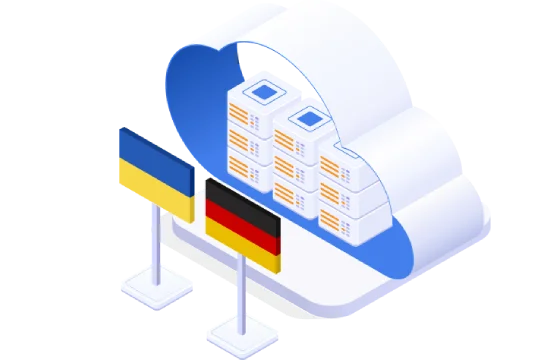
- 4 availability zones in Ukraine and Germany
Choosing a Cloud Provider? Why De Novo?
Our customers trust us with the data their business continuity, operations, and commitments to government, partners, and society depend on.

Proven infrastructure availability

Customer satisfaction

of our customers have stayed with De Novo for over 10 years

Financially backed SLA commitments

Financial stability backed by UAH 330 million in charter capital and our shareholders

Independently audited by KPMG every year

Who will support you?

Personal manager
handles business and commercial matters

Cloud engineer
designs cloud solutions tailored to your requirements

Customer success manager
ensures service quality and that our team meets De Novo’s operating standards

Support engineers 24/7/365
A Level 2 technical support team available around the clock
De Novo Cloud Solutions
Cloud infrastructure designed for large enterprises and complex IT landscapes, along with an ecosystem of related services

A cloud platform powered by Kubernetes and NVIDIA GPUs for running artificial intelligence and machine learning (AI/ML) workloads

Cloud infrastructure for the stable functioning of mission-critical systems, featuring an ecosystem of disaster recovery and backup services
Cases

We’ll explain the performance gains that switching from the NVIDIA H100 to the H200 can deliver, and under what conditions a Ukrainian cloud provider has an advantage over hyperscalers

“17,000 unregistered properties” — By the end of this year, Ukraine plans to update the Unified Tourism Registry

AI for Reviewing Construction Projects: How a “Digital Inspector” Analyzes Documents, Identifies Errors, and Automates Processes in Ukraine's Public Sector

The e-Permit service has received an AI module that automatically checks documents, relieving officials of routine tasks

This unique model could change cardiac diagnostics worldwide. Powered by biosensors and NVIDIA H100 capabilities, the system performs diagnostics in minutes instead of hours

This is a story about how artificial intelligence helps the ministry review applications for youth exchanges: it analyzes estimates, filters out vague goals, identifies unjustified expenses, and suggests areas that need clarification

We went to an AI conference for you, and now we're telling you a story about how buying a cheap camera almost ruined a project to implement computer vision at a company. And that's not the only thing that went wrong

Fields are too large, there are too few agronomists, and the weather is too unpredictable. Could AI be the answer? Kernel is implementing 12 ML models — from growth phase forecasting to agrologistics — and showing how to transform agribusiness through data

The Ministry of Youth and Sports of Ukraine has launched the country's first service based on large language models (LLM) on the Dія.Engine platform. The most powerful equipment in Ukraine was used to host the LLM

Every company goes through its own “digital transformation” journey, and each case is unique. This is especially true when it comes to national-scale organizations

The success of an agricultural company today largely depends on information technology. Increasing yields, optimizing logistics, achieving deep automation of routine operations, and ensuring full mobility of employees—all this is possible thanks to the effective use of IT

We discussed how “digital transformation” works in specific examples in the country with Yevhen Yentis, a person without whose participation it is difficult to imagine the success of such national-scale projects as Prozorro and “New Customs”

Interview with Andriy Begunov, Director of the Information Technology Department at PUMB Bank, which ranks among Ukraine's top seven banks in terms of assets (according to data from the National Bank of Ukraine)

The Ministry of Justice of Ukraine is creating an AI assistant that will answer legal questions 24/7. The project will run on LLM in the secure De Novo cloud
Talk to a Cloud Expert
Cloud services — Q&A
Information is today one of the most valuable assets of businesses, non-profit organizations, and government institutions. The demand for convenient, flexible, and reliable IT solutions is growing with acceleration from year to year. Therefore, cloud technologies continue to conquer the market confidently, helping users optimize costs, increase productivity, and scale business.
Who is a cloud provider?
A cloud provider is a specialized company that provides access to computing resources, software, and even entire software platforms and services via the Internet. This means that users of cloud services do not need to invest in purchasing, maintaining, and maintaining on-premise equipment, software licenses, hiring expensive IT specialists, etc. A cloud provider with equipment performs all these tasks in one or more data centres. At the same time, if there is a communication channel, the user can access cloud IT resources from anywhere in the world, paying for them as they are used. This, in particular, means that the client can minimize capital expenditure and transfer CAPEX to OPEX.
Unlike hosting providers specialising in hosting websites on their servers, cloud providers offer a much more comprehensive range of features and services. There are three main models of providing cloud services:
IaaS (Infrastructure as a Service) — remote rental of virtual servers, data storage, networks and other IT resources.
PaaS (Platform as a Service) is an on-demand platform for developing and deploying applications.
SaaS (Software as a Service) — access to software in the cloud via the Internet.
Each model will be optimal for different business tasks, but increasingly, companies and organizations rely on a combination of these approaches in their activities. Within the general models of IaaS, PaaS, and SaaS, hundreds of specialized services provided by cloud service providers have been developed.
What are the advantages of cloud technology for business?
Cloud providers provide cloud services on the "as a service" model. This means that users can access these services anytime, anywhere, and at any volume, paying only for the resources used. This approach provides flexibility and cost savings.
Why do businesses choose cloud technologies? Mainly because they provide several significant benefits, such as reduced capital investment, as there is no need to purchase and maintain expensive equipment. Cloud scalability allows you to quickly and easily increase or decrease resources according to changing business needs, and the ability to work from anywhere in the world (with Internet access) provides significant flexibility when working with IT infrastructure. It is also worth noting such benefits as increased productivity, cost optimization (paying only for used resources), simplifying the deployment of IT infrastructures and increasing their reliability, reducing downtime (high availability and fault tolerance), increasing the mobility of employees and improving interaction between them.
Choosing a cloud provider - what should you pay attention to?
To choose a cloud service provider (or IaaS provider, PaaS provider), first of all, pay attention to such factors as:
- List of available services, their relevance and relevance to your business needs
- Cost of services
- Guaranteed level of security and fault tolerance of the cloud IT infrastructure
- Scalability — the ability to expand resources in the future
- Reviews of other users
- The level of SLA (Service Level Agreement) — what are the guarantees of the quality of services provided
- Compliance with legal requirements, for example, in the field of confidential data protection
- Providing technical support to clients
- Availability of profile certificates from state bodies, global manufacturers and trusted international organizations
Cloud technologies continue to develop dynamically, opening ever-wider opportunities for business. Moving to the cloud allows companies to optimize costs, increase productivity, and respond more quickly to constant market changes.
Where Should Data Be Stored in Ukraine to Comply with Legal Requirements?
The choice of where to store and process data depends on the type of information, the industry, and the regulatory requirements applicable to a particular organization. In Ukraine, the use of cloud technologies is governed, among other regulations, by the Law of Ukraine "On Cloud Services." Additional requirements concerning information security, risk management, and cooperation with cloud service providers apply to the public and financial sectors.
Banks and certain other financial institutions are also subject to specific National Bank of Ukraine (NBU) data storage requirements and regulations governing the use of cloud computing technologies. In particular, NBU Board Resolution No. 99 has been in effect since November 1, 2025, approving the "Regulation on the Procedure for Using Cloud Computing Technology." The regulation establishes requirements for managing risks associated with cloud services, entering into agreements with cloud providers, and notifying the NBU about the use of cloud technologies. Responsibility for regulatory compliance rests with the financial institution using these services.
A cloud provider for government institutions must comply with Ukrainian legislation concerning information security and IT infrastructure. Depending on the circumstances, additional requirements may apply to a customer's information system, including those related to the Comprehensive Information Security System (CISS), security controls, access management, and other measures. Therefore, the data storage architecture and locations must be determined based on the criticality and regulatory status of the customer's IT systems.
Is De Novo a Suitable Cloud Provider for Government Systems and Banks?
Yes. De Novo's hardware and software infrastructure has been designed and implemented to support mission-critical information systems in the public and financial sectors. As a cloud provider for government systems, De Novo offers services whose compliance with Ukrainian and international information security requirements has been formally verified.
In particular, De Novo's cloud service management systems and IaaS/PaaS cloud services hold certificates of compliance with Ukraine's Comprehensive Information Security System (CISS) requirements. The company's operational processes and information security management are certified according to international standards ISO/IEC 27001, ISO/IEC 27017, ISO/IEC 27018, and ISO/IEC 27701. Its cloud infrastructure and data centers are also certified for compliance with the PCI DSS standard. De Novo is also a reliable cloud provider for banks, payment companies, and other financial institutions, which have accounted for a significant share of the company's customers for many years.
How Does De Novo Ensure Uninterrupted Cloud Operations During Prolonged Power Outages or Blackouts?
Operational continuity is maintained at two main levels: engineering (physical) and software (logical). In particular, De Novo's own data centers receive electricity from different substations through several independent high-voltage power lines. In the event of a short-term interruption to the external power supply, uninterruptible power supply (UPS) systems keep the data center equipment running. During prolonged outages, backup diesel generator sets take over. On-site fuel reserves enable a data center to operate autonomously for up to 72 hours, while longer outages can be supported by refueling the generators without shutting them down. To ensure fuel availability, De Novo has agreements with several independent fuel suppliers.
At the logical level, cloud infrastructure resilience is enhanced through the geographical distribution of resources across several independent De Novo cloud locations in Ukraine and Germany. Data replication, backup, and disaster recovery technologies enable secure copies of IT systems to be maintained at geographically separate sites located up to 1,500 km apart, allowing customer data and services to be restored in the event of a failure or disaster. The combination of physical and logical redundancy supports uninterrupted IT infrastructure operations and reduces the risk of data loss even during large-scale blackouts or major incidents. Additional reliability is provided through 24/7 monitoring, technical support, and incident response procedures proven in real-world conditions.
How Is a Company's Infrastructure Migrated from On-Premises Servers or AWS/Azure to the De Novo Cloud?
The first step in migrating existing infrastructure is an assessment of the current IT environment. Specialists examine the customer's hardware and software infrastructure, identify system interdependencies, evaluate data volumes, and determine availability and recovery time requirements. Based on the assessment, a target cloud architecture and migration strategy are developed.
Migration to De Novo as a cloud provider can be performed from on-premises physical or virtual infrastructure, as well as from other cloud platforms, including AWS and Microsoft Azure. The process begins with a test migration of selected IT systems and data. If no issues are identified, the main workload migration proceeds, followed by optimization. For business-critical services, a phased or "warm" migration approach is used to minimize downtime and provide a rollback option to restore the original configuration if necessary.