




VMware Tanzu — what it is and its role in using Kubernetes clusters
2024-07-16

VMware, which recently became part of Broadcom, remains a recognized global leader in hypervisor virtualization, but at the same time, its portfolio includes a wide range of solutions for a variety of tasks, including working with containers. In this area, the company offers a family of powerful products under the common brand name VMware Tanzu.
What is VMware Tanzu
VMware Tanzu is a set of open source tools that allows users to create, deploy, and manage containerized applications in any cloud environment (including multi-cloud) using Kubernetes (K8s) technology, which has become the de facto standard in the world of container technologies. Today, VMware Tanzu combines a whole family of related products, each with its own specialization. For example, Tanzu Build Service provides automated production, management, and control for containers. Tanzu Kubernetes Grid provides a comprehensive enterprise-grade environment for K8s clusters. Tanzu for Kubernetes Operations is responsible for automating various operations with the Kubernetes (K8s) platform, and Tanzu Application Service is a modern environment for deploying and operating microservices. There are other products as well, such as Tanzu Application Catalog, Tanzu Application Platform, Tanzu Data Services, and more. What they all have in common is that they are designed and selected to cover the entire lifecycle of developing and operating microservice applications. The Tanzu family provides complete control, management, and monitoring for K8s clusters in on-premises, cloud, and hybrid infrastructures.
The main advantages provided by VMware Tanzu include:
- Accelerated application development and deployment in any cloud: private, public, or hybrid.
- Improved application performance and reliability through robust monitoring and management tools.
- Reduced IT costs by optimizing resource utilization and improving IT infrastructure efficiency.
- Enhanced cybersecurity and data protection, ensuring regulatory compliance.
- Simplified application management.
- Reduce downtime—VMware Tanzu's proprietary technologies help improve application availability and resilience.
- Improve collaboration between teams—Tanzu enables developers and DevOps to work together more effectively.
- Support for a wide range of programming languages, runtime environments, and tools.
Thus, VMware Tanzu is a comprehensive solution for working with container technologies (in particular, Kubernetes clusters), which promotes the digital transformation of enterprises and organizations, helps improve the efficiency of IT infrastructure, and reduces costs.
The key point here is that the VMware Tanzu family of products provides all the necessary tools for running containers and K8s clusters, and can also work within the VMware vSphere proprietary platform, which is currently the de facto standard for software virtualization and is used by commercial companies, government organizations, and cloud operators around the world (including De Novo, which, as a reminder, has the highest VMware Cloud Verified and Principal Partner statuses, among others).
VMware products included in Tanzu
VMware Tanzu includes a whole family of diverse software components, the main ones being tools such as:
- Tanzu Kubernetes Grid (TKG)
- Tanzu Application Service (TAS)
- Tanzu Mission Control (TMC)
- Tanzu Observability
- Tanzu Application Catalog (TAC)
- Spring Boot
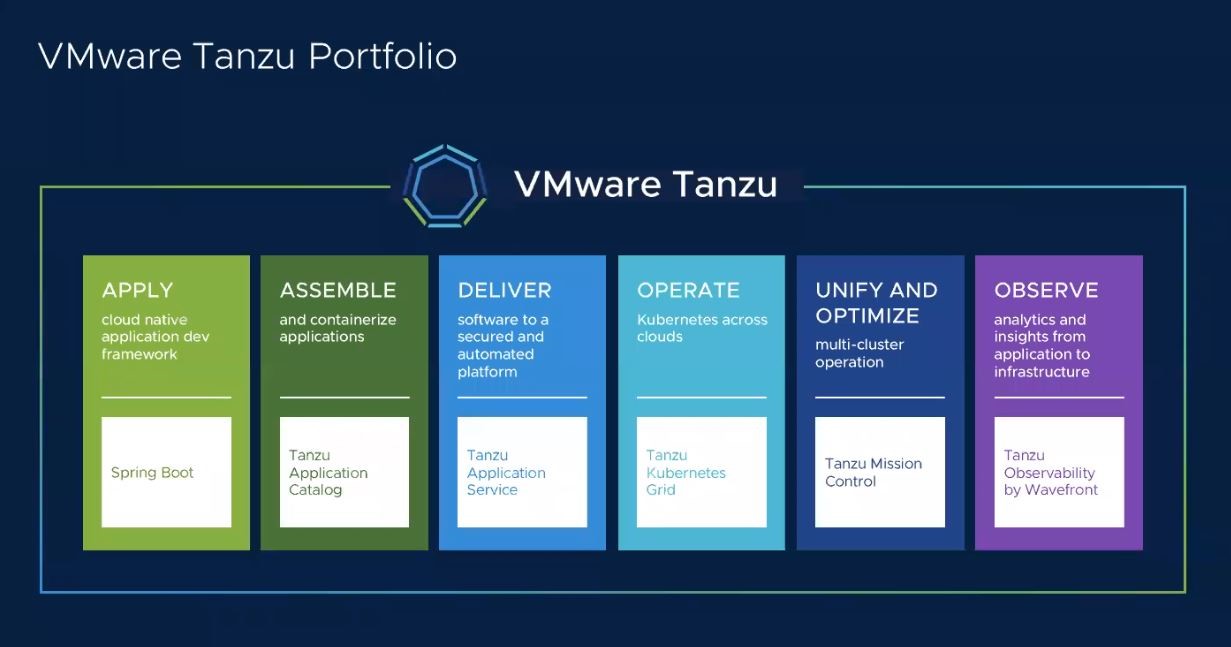
Tanzu Kubernetes Grid (TKG) is a platform for creating, managing, and operating Kubernetes clusters in on-premises, cloud, and hybrid environments. It provides ease of deployment, automation, security, compliance, and integration with other VMware Tanzu products. TKG is suitable for developers, operators, and enterprises who want to modernize their applications and infrastructure.
Tanzu Application Service (TAS) is a platform for developing, building, deploying, and managing containerized applications. It allows developers to quickly and easily develop, build, and deploy containers, and operators to manage their lifecycle. TAS is designed for developers, users, and enterprises that want to improve and optimize their applications and infrastructure.
Tanzu Mission Control (TMC) is a management platform for all VMware Tanzu products. It provides centralized management, monitoring, analysis, automation, and security for VMware Tanzu products. TMC is suitable for companies and organizations that want to optimize the use of VMware Tanzu products and improve their performance.
Tanzu Observability is a platform for monitoring and analyzing the performance and health of container applications. It allows developers to debug and optimize container applications, operators to monitor the performance and availability of container applications and identify problems, and enterprises to improve the efficiency of container applications and reduce costs.
Tanzu Application Catalog (TAC) is a catalog of containerized applications that allows developers and operators to find, deploy, and manage containerized applications from various sources. TAC is suitable for developers, operators, and enterprises that want to standardize the use of containerized applications and improve efficiency.
Spring Boot is a framework for developing Java applications that simplifies the process of developing and deploying microservices. Spring Boot allows developers to quickly and easily create modern, scalable, and reliable Java applications and simplify the process of deploying and managing them.
VMware vSphere with Tanzu
A typical stack for deploying microservice infrastructure today consists of three main layers: the base virtual environment, the Kubernetes infrastructure deployed within virtual machines, and the containers themselves. The problem is that each of these layers is usually managed by a separate team and controlled by its own specialists—the basic virtual infrastructure is managed by a vSphere administrator, the container clusters are managed by a DevOps engineer (Kubernetes administrator), and the containers themselves are used by application developers.
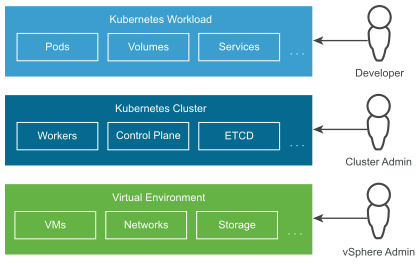
This approach has obvious drawbacks, at least because different teams do not have full visibility or control over adjacent environments. That is, for example, developers cannot see the entire stack, which may contain hundreds of microservice applications, DevOps engineers do not have the tools to manage or monitor the virtual environment and solve problems related to resource allocation, and vSphere administrators cannot observe the entire container infrastructure, the placement of various Kubernetes objects in the virtual environment, and how they use resources. Thus, the lack of deep integration between different levels of the stack can create significant problems with planning and executing microservice workloads. In addition, managing such an architecture becomes a very difficult task, which becomes radically more complicated as container infrastructures grow in scale.
To address these issues, vSphere with Tanzu was created, which allows vSphere to be transformed into a platform for running Kubernetes workloads. In other words, with vSphere with Tanzu, you can use containers in the same way as virtual machines without unnecessary architectural layers and the additional complexity they entail. This is made possible by VMware's proprietary vSphere Pod technology. Its key element is special modules (vSphere Pods) that are deployed directly on the VMware ESXi hypervisor using software agents. In essence, vSphere Pod is a small virtual machine, similar to the K8s module, inside which one or more Linux containers run.
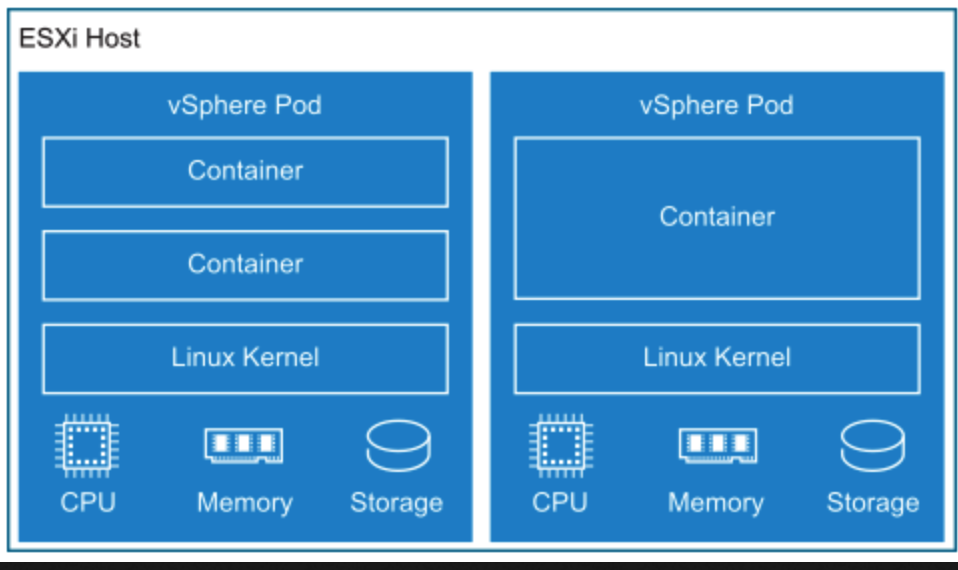
The size of each such module is reserved according to the workload it must support — the optimal amount of storage, RAM, and processor resources is allocated. The VMware NSX-T Data Center module is used to connect Pods into a network, and the entire stack is managed using Supervisor Cluster and a special control panel (Control Plane). As a result, already at the stage of deploying the container infrastructure, the user immediately gets the ability to create isolated resource blocks (as in the case of classic virtual machines), advanced centralized management tools for the entire container infrastructure, monitoring and diagnostic tools, a role-based conditional access system, and more. It should be noted that vSphere Pod modules are fully compliant with Open Container Initiative (OCI) specifications and can run (OCI-compatible) containers from any operating system.
Benefits and key features of VMware vSphere with Tanzu
VMware vSphere with Tanzu is a comprehensive solution that combines the virtualization capabilities of vSphere with the Tanzu container management platform. Implementing vSphere with Tanzu offers organizations a number of benefits, including:
Cloud application development. Creating and deploying cloud applications using Kubernetes provides increased software flexibility and scalability.
Application modernization. Migrating existing applications to containers and deploying them in Kubernetes without downtime, as well as simplifying the development and maintenance of microservices.
- Versatility. Deploying applications in on-premises, cloud, or hybrid environments provides the freedom to choose the optimal infrastructure for each application.
- Ease of use. Familiar vSphere tools and interfaces make working with the platform easy and convenient. It also reduces the time required to learn and adapt to new technologies.
- Security. Comprehensive application protection at all levels, implementation of data cybersecurity, authentication, authorization, and network security features.
- Scalability. Easy scaling of vSphere with Tanzu to meet changing business needs, support growing data volumes and application workloads.
Reliability. VMware vSphere with Tanzu is based on the reliable vSphere platform, which guarantees high availability and application performance. It also reduces the risk of downtime and failures.
De Novo's ready-made solutions based on VMware Tanzu
De Novo now offers a whole range of cloud services based on the VMware Tanzu platform:
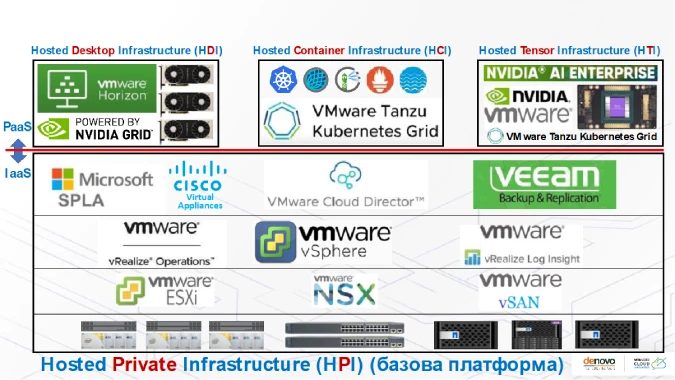
Hosted Container Infrastructure (HCI) is a platform for orchestrating Kubernetes clusters, designed for DevOps professionals and PaaS developers. It is based on VMware Tanzu Kubernetes Grid and provides functionality and ease of use comparable to AWS Elastic Kubernetes Services, Google Kubernetes Engine, and MS Azure Kubernetes Services. HCI is deployed in a private cloud (which, in turn, operates in a reliable and secure De Novo data center) and is deeply integrated with IaaS. This allows for efficient use of resources without additional software layers, using standard tools (CSI, CNI, K8s Operators) without the need to understand the details of the platform's architecture. HCI includes monitoring, updating, and 24/7 production-grade support.
Kubernetes as a Service (KaaS) is a modern, industrial-grade Kubernetes cluster orchestration platform deployed in the De Novo collective cloud. KaaS is based on the VMware Tanzu Kubernetes Grid (TKG) technology stack and Cloud Director Container Services Extension tools, which allow you to manage the entire lifecycle of K8s clusters directly from the graphical interface of the Cloud Director cloud operations portal or via the vCD API. KaaS coexists and integrates seamlessly with virtual data centers (IaaS) in Cloud Director. The functionality and ease of use of KaaS is similar to Managed Kubernetes services from hyperscalers (AWS Elastic Kubernetes Services, Google Kubernetes Engine, MS Azure Kubernetes Services).
Hosted Tensor Infrastructure (HTI) is an innovative Kubernetes platform for artificial intelligence (AI) and machine learning (ML) tasks, based on the VMware vSphere, VMware Tanzu Kubernetes Grid, and NVidia AI Enterprise technology stack, equipped with NVIDIA GPU H100 / L40S accelerators with tensor cores and deployed on the De Novo HPI (Hosted Private Infrastructure) private cloud. Tensor GPU/TPU accelerators deliver unmatched performance for machine learning and high-performance inference tasks.
At the same time, the private cloud as a service (HPI) model provides a physically isolated and secure VMware vSphere virtual infrastructure that is used exclusively by the customer. HTI inherits all the advantages of HPI and flexibly adapts to business requirements, has extended functionality, and provides the ability to deeply integrate with your own infrastructure, including the option to install the complex on the customer's premises.
Tensor Cloud is Kubernetes as a Service, enhanced with GPU/TPU with tensor cores for running artificial intelligence and machine learning (AI/ML) workloads. The platform combines NVIDIA H100/L40S accelerators and an integrated technology stack based on VMware vSphere, VMware Tanzu Kubernetes Grid, and NVIDIA AI Enterprise. Tensor accelerators deliver unmatched performance on machine learning and high-performance inference tasks.
All De Novo cloud services provide users with complete cost predictability due to the absence of unpredictable cost components (traffic, disk operations, etc.), full compliance with Ukrainian legislation, as well as the functionality and reliability of hyperscalers at the price of GPU Cloud discounters.