


De Novo AI Studio — a quick start into the world of generative AI
AI Studio is a ready-made environment where you can create your own applications with generative AI, test them, and safely connect them to business processes. The platform is suitable for both development teams and specialists without in-depth technical knowledge, as it supports a low-code/no-code approach, i.e., creating solutions without programming or with minimal code.
De Novo AI Studio is a Ukrainian platform for working with generative artificial intelligence, built on the De Novo Tensor Cloud. It helps companies quickly launch and develop AI solutions — without complex configurations and technical barriers. Whereas previously it could take weeks to implement an AI model, with AI Studio the process takes just a few hours.
The platform is based on a convenient system for managing models, monitoring their performance, and analytics. You can choose how the AI will process requests, track performance, and flexibly manage resources. All this takes place in an isolated and secure environment that meets the highest compliance and data protection requirements.
In other words, De Novo AI Studio is a workspace for generative AI that takes care of the technical side, leaving you to focus on what matters most — creating value for your business.
Advantages of De Novo AI Studio
Ready to use
AI Studio is available in the form of templates with interconnected virtual machines that can be deployed in the De Novo Tensor Cloud within a few dozen minutes.
After deployment, the user receives a fully ready environment with integrated services, authentication, monitoring, and backup — all in Ukraine.
Security and sovereignty
AI Studio operates in a Ukrainian cloud certified according to ISO 27001, PCI DSS, and KSZI. Data and models are stored in secure segments with full access control.
The platform allows you to implement AI projects for businesses under Ukrainian jurisdiction, with full control over the infrastructure and transparent pricing and flexible deployment rates.
Architecture and components
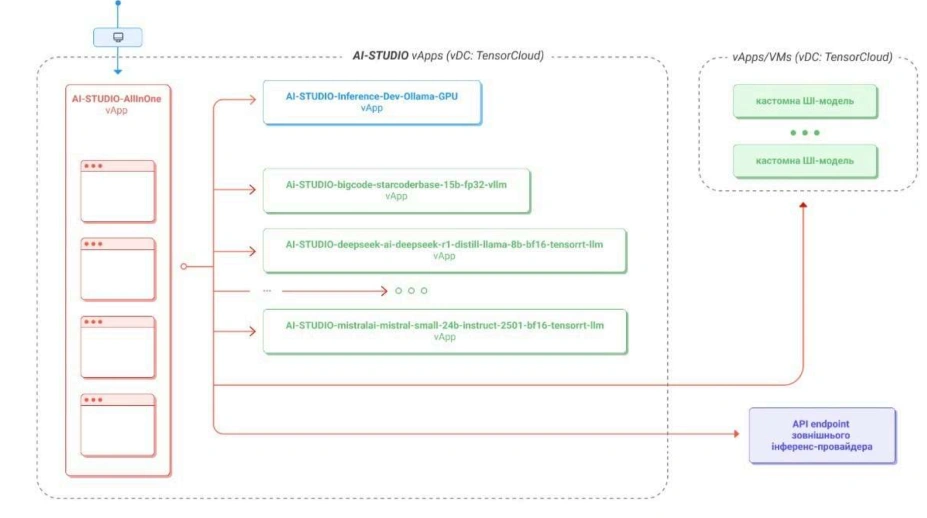
The AI Studio platform is built on a modular principle and combines proven open-source tools that together form a complete environment for GenAI — from data collection to monitoring and automation.
Monitoring and observability
Components such as Beszel, Glances, and Dozzle provide control over system performance—they collect metrics from containers and servers, display historical data, allow real-time log tracking, and quickly diagnose failures.
AI application development and orchestration
Dify combines Backend-as-a-Service with LLMOps, simplifying the creation of generative applications even without programming.
Langfuse helps teams analyze model performance, debug responses, and improve LLM performance.
LiteLLM acts as a universal gateway that supports over a hundred LLM APIs (OpenAI, Anthropic, Azure, Bedrock, Vertex AI, Hugging Face, etc.), providing flexibility and standardization of calls.
Inference and interaction with models
Ollama and Open WebUI create a secure environment for running large language models locally with support for GPUs, caching, RAG, and modern interfaces.
Lobe Chat adds a user frontend for AI chats, supporting multiple model providers (OpenAI, Claude, Gemini, DeepSeek, Qwen, Ollama) and the ability to connect custom knowledge bases.
Data processing and enrichment
Docling unifies document handling—from PDF and Word to audio and HTML—by converting them into structured data suitable for LLM.
Firecrawl automatically converts web pages into clean, structured datasets ready for analytics or model training.
Perplexica performs intelligent real-time search, combining machine learning capabilities with open web search.
SearXNG aggregates results from over 250 sources, providing private and accurate search without user tracking.
Integration and automation
n8n combines AI components with company business processes, automating tasks from data preparation to communication between services.
Portainer simplifies container management in Docker, Swarm, and Kubernetes, enabling rapid deployment and scaling of AI Studio infrastructure.
Try AI Studio today
De Novo AI Studio in Tensor Cloud is the fastest way to go from idea to working GenAI solution in Ukraine. Contact the De Novo team to get a demo, consultation, or deploy your own project within a day — experience how a new generation AI tool makes automation with AI Studio simple, fast, and more secure.
14 days Free Trial
What is De Novo AI Studio and what is the platform designed for?
De Novo AI Studio is a Ukrainian generative AI (GenAI) platform that provides a ready-to-use environment for building, testing, deploying, and operating AI applications. It is deployed in De Novo Tensor Cloud and brings together tools for working with models, data, automation, and monitoring in a single environment. This means teams do not have to assemble the entire software stack from separate components before they can start experimenting.
From a practical perspective, AI Studio is a platform for building AI applications that enables teams to move from an idea and prototype to a solution ready for integration into business processes. Potential use cases include LLM assistants based on Large Language Models, chatbots, RAG solutions for corporate data, and document analysis systems. The platform has a modular architecture and includes tools for monitoring infrastructure, logs, and LLM applications. This makes it possible to test scenarios, analyze solution behavior, and monitor applications after deployment.
Particular emphasis is placed on a low-code/no-code approach, enabling solutions to be created with minimal programming or, for some operations, without writing code at all. As a result, AI Studio can be used both by development teams and by specialists who need a faster way to start working with GenAI without configuring the entire infrastructure themselves. The environment is deployed from ready-made templates of interconnected virtual machines in Tensor Cloud, after which users receive integrated services, authentication, monitoring, and backup capabilities.
What AI solutions can be built with De Novo AI Studio?
De Novo AI Studio enables organizations to move beyond experiments with Large Language Models and build AI applications that address specific business needs. One of the core use cases is a corporate AI assistant connected to the company's internal knowledge sources. It can help employees find information in policies, instructions, and technical documentation, prepare answers, and work with accumulated corporate knowledge. The same technology foundation can be used to build customer and contact-center chatbots, automate the processing of routine inquiries, draft responses, or summarize conversations.
Another important area is AI-powered document processing. The Ukrainian platform can be used to implement a RAG system (Retrieval-Augmented Generation), which retrieves relevant information from corporate sources before generating an answer and provides it to the language model as context. This approach is used for intelligent search, document analysis, and corporate knowledge bases. The Docling component helps convert PDF, DOCX, XLSX, PPTX, and other formats into structured data suitable for indexing, semantic search, and RAG. This is a practical use case for organizations that work with large volumes of contracts, instructions, reports, and other documentation.
Generative models can be used to generate and transform text content, while automation tools can connect AI to internal systems and business workflows. This also enables the development of AI agents: scenarios in which a model works together with tools, data, and a defined sequence of operations. For example, an AI component can receive a request, analyze its context, and pass the result to the next stage of a business process. The specific functionality of such an agent depends on the connected systems, models, and workflow design; the platform itself does not mean that every business process can be automated out of the box.
Practical examples of such solutions are already operating or being developed on De Novo infrastructure. For example, an LLM service was created for Ukraine's Ministry of Youth and Sports to review applications for youth exchanges, identify common errors, and generate recommendations. In the e-Permit (єДозвіл) system, AI analyzes licensing documents, compares information from different sources, and prepares a conclusion for a responsible official. An AI agent is also being developed for the Ministry of Justice to answer citizens' common legal questions on a 24/7 basis.
Is De Novo AI Studio an alternative to Microsoft Azure OpenAI Service?
For selected use cases, the De Novo platform can be considered a functional alternative to Microsoft Azure OpenAI Service, which in Microsoft's current ecosystem is represented as Azure OpenAI in Microsoft Foundry Models. These use cases include building GenAI applications, API-based model access, RAG systems, and solutions that work with internal knowledge bases. It can serve as a Ukrainian alternative to Microsoft Azure OpenAI Service for organizations that need to host AI infrastructure and process data in De Novo's cloud in Ukraine.
The solution does not restrict users to OpenAI models. Ollama can be used to run open-source LLMs locally, while LiteLLM makes it possible to connect external APIs from different providers. This allows local and external models to be combined depending on the task, data requirements, and application architecture. For example, a RAG solution can use a company's internal knowledge base and pass the retrieved context to a local LLM. If an application uses an external API, data-processing conditions will depend on the selected model provider. At the same time, the services are not fully identical: Microsoft Foundry has a broader proprietary ecosystem of models, agents, and integrated Azure services.
How does De Novo AI Studio differ from Microsoft Foundry and Azure AI Studio?
Microsoft Foundry is the current name of Microsoft's AI platform, which previously evolved under the names Azure AI Studio and later Azure AI Foundry. It is deeply integrated with Azure and the Microsoft ecosystem, including cloud infrastructure, models, data services, security, monitoring, and AI-agent development tools. Therefore, De Novo AI Studio should be compared with Microsoft Foundry at the level of specific GenAI use cases. Microsoft's ecosystem is significantly broader than the set of capabilities where the two platforms overlap.
De Novo AI Studio follows a different architectural approach. It is a modular environment built on open-source components for working with LLMs, RAG, automation, monitoring, and other elements of AI applications. The platform supports local open-source models as well as external AI services connected via API. As an Azure alternative, the Ukrainian AI Studio platform is primarily designed for scenarios where infrastructure localization and control are important. The AI platform operates in De Novo's cloud infrastructure under Ukrainian jurisdiction, while local model inference makes it possible to build scenarios in which data is processed without sending requests to an external LLM provider.
Is De Novo AI Studio an alternative to Gemini Enterprise Agent Platform and Vertex AI?
For selected GenAI use cases, De Novo AI Studio can be considered an alternative to Vertex AI and Gemini Enterprise Agent Platform (Vertex AI). It is important to take Google's naming changes into account: in 2026, Vertex AI Platform was renamed Gemini Enterprise Agent Platform. The new platform builds on Vertex AI capabilities and combines work with models, enterprise data, and AI agents, including their deployment, management, and monitoring.
There is practical overlap with De Novo AI Studio in GenAI workloads. Both platforms support working with language models, building AI agents for business, connecting enterprise data, implementing RAG systems, automating workflows, and monitoring AI applications. Gemini Enterprise Agent Platform, however, is tightly integrated with Google Cloud services and infrastructure.
De Novo AI Studio is built around a modular set of open-source components and does not require an AI project to be tied to the Google ecosystem. Organizations can use local open-source LLMs, connect external models via API, and design their own architecture for working with corporate data. This makes the platform an alternative to Vertex AI for scenarios where infrastructure control and local language-model inference are important.
The platforms nevertheless differ in scope. Gemini Enterprise Agent Platform includes Google's mature toolset for managing the machine-learning model lifecycle, including Pipelines, Model Registry, Feature Store, Model Evaluation, Model Monitoring, and other services. De Novo AI Studio does not replicate this entire toolset. Therefore, describing it as an “alternative to Gemini Enterprise Agent Platform” is appropriate only for specific GenAI scenarios supported by both platforms.
Is De Novo AI Studio an alternative to Google AI Studio?
De Novo AI Studio can be used as an alternative to Google AI Studio for rapid development and testing of GenAI applications. Google AI Studio is primarily focused on working with Gemini models and the Gemini API. De Novo AI Studio, by contrast, supports different LLMs, including local open-source models and external models connected via API.
As an LLM platform, De Novo AI Studio goes beyond prompt and model testing. It allows organizations to combine LLMs with corporate data, RAG, automation, and monitoring and, where required, run inference on local models within De Novo infrastructure. This makes it possible to use one platform both for prototyping and for the subsequent operation of enterprise AI applications.
For companies that require a controlled enterprise GenAI environment, De Novo AI Studio can therefore serve as an alternative to Google AI Studio. In this context, the phrase “Ukrainian alternative to Google AI Studio” refers to a functional alternative for selected tasks rather than a complete match to Google's service in terms of architecture and capabilities. A key difference is the ability to run models locally and maintain control over infrastructure in the De Novo cloud.
Is De Novo AI Studio an alternative to Amazon Bedrock?
De Novo AI Studio can be considered a functional alternative to Amazon Bedrock for selected generative AI scenarios. Both platforms enable organizations to work with different LLMs, build GenAI applications and AI agents, use RAG to connect corporate data, and create orchestrated AI workflows. Amazon Bedrock, however, is a fully managed AWS service integrated with other components of the Amazon cloud ecosystem.
De Novo AI Studio follows a different model. It is a modular platform that supports local open-source LLMs as well as external models connected through APIs. In this context, an alternative to Amazon Bedrock means the ability to implement a similar applied GenAI scenario using a custom architecture and component stack.
For Ukrainian organizations, deployment location can be a material differentiator. De Novo AI Studio operates in De Novo infrastructure in Ukraine and under Ukrainian jurisdiction, allowing customers to build a controlled local environment and process requests to a language model without using an external API when a local model is selected. Therefore, the terms “Ukrainian alternative to Amazon Bedrock” or “AWS Bedrock alternative” are appropriate for specific GenAI tasks, but they do not imply replication of the full Amazon Bedrock feature set or the broader AWS ecosystem.
Which language models can be connected to De Novo AI Studio?
De Novo AI Studio supports different LLMs and allows organizations to combine local model execution with access through external APIs. Ollama and GPU-enabled Open WebUI are used to run models locally within the platform. De Novo's LLM Cloud ecosystem also includes dozens of prepared models, including Gemma, DeepSeek, Granite, Llama, Mistral, and others.
For external models, AI Studio uses LiteLLM, a universal gateway that supports more than one hundred LLM APIs and provides standardized access through an OpenAI-compatible API. Confirmed integrations include OpenAI, Anthropic, Microsoft Azure, Amazon Bedrock, Google Vertex AI, and Hugging Face. This enables different providers to be connected through a single API layer.
The Lobe Chat component also supports OpenAI, Claude, Gemini, DeepSeek, Qwen, and Ollama. This allows different LLMs to be used within a single enterprise AI environment—for example, a local model for one scenario and an external API for another. This approach makes De Novo AI Studio a multi-model AI platform and reduces the dependence of application architecture on a single provider.
The actual availability of a specific model or model version depends on the AI Studio configuration, the licensing terms of the model itself, the capabilities of the relevant API provider, and the selected GPU resources for local language-model execution.
Can LLMs be run locally without sending data to external AI providers?
Yes. De Novo AI Studio supports local LLM execution, with the language model running directly within De Novo infrastructure. Ollama and Tensor Cloud GPU resources are used for this purpose. In this configuration, model requests are processed locally without a mandatory connection to an external AI provider.
The key distinction is that a private LLM operates within a controlled environment, whereas an external API involves sending a request to a third-party service such as OpenAI, Anthropic, or Google. Therefore, an AI scenario without transferring data to an external provider is possible when the application uses a local model and does not rely on external services at individual processing stages.
A practical example of this low-code approach is the AI module of the e-Permit (єДозвіл) system of Ukraine's Ministry of Economy. Locally deployed Gemma 3 and Qwen 2.5 models are used to analyze applications, with all computation performed in a Ukrainian data center and no calls to third-party AI APIs. One model analyzes text and generates recommendations, while the other processes attached documents.
The actual data path, however, depends on the specific architecture. Even if the primary model runs locally, a solution may still use external APIs, analytics services, storage systems, or other integrations. It is therefore more accurate to say that De Novo AI Studio enables organizations to build a secure LLM platform with local data processing, while the final data-flow design depends on the configuration of each project.
How does De Novo AI Studio work with corporate documents and RAG?
De Novo AI Studio enables organizations to build enterprise RAG solutions in which a language model receives context from the company's internal documents. This architecture is suitable for corporate knowledge bases, internal search, documentation analysis, and chatbots based on company documents.
The process begins with document preparation. The Docling component in AI Studio works with PDF, DOCX, XLSX, PPTX, HTML, and other formats and converts documents into structured data suitable for subsequent search and analysis. During document processing, Docling helps preserve structure, including headings, tables, and related text fragments, which is important for subsequent indexing and retrieval. This is particularly relevant for AI document-processing scenarios, because basic extraction of plain text often destroys the structure of tables, headings, and related document fragments.
Once the materials have been prepared, they can be used to build a corporate knowledge base and configure RAG. Documents are indexed, and their fragments can be converted into vector representations—numerical descriptions of content used for semantic search. When a user asks a question, the system retrieves the fragments that are semantically closest to the query and adds them to the context provided to the LLM. The model therefore receives retrieved corporate information as additional context, although this does not completely eliminate the risk of incorrect answers.
A practical example of an LLM working with a controlled knowledge base is the AI-agent project for Ukraine's Ministry of Justice free legal aid system. Its knowledge base is built from verified legal materials, with plans to connect the Unified State Register of Legal Acts and other government sources. The agent is intended to retrieve relevant information and generate answers to common legal questions from citizens. The LLMs operate locally in De Novo's secure cloud infrastructure, and access to third-party Internet resources is not envisaged for this scenario.
Another De Novo use case is the “Digital Inspector” for the State Inspection of Architecture and Urban Planning of Ukraine (DIAM). The AI system analyzes large sets of construction documentation, structures the data, and uses RAG to retrieve relevant context, including construction standards, source data, urban-planning conditions, and restrictions. The LLM then helps identify omissions, contradictions, and inconsistencies in the documents. De Novo's cloud platform with NVIDIA GPUs is used for development and testing.
At the user level, AI Studio includes Open WebUI and Lobe Chat with knowledge-base and RAG support, while Dify can be used to build more sophisticated AI applications. If document processing needs to be incorporated into a broader business process, n8n can connect AI components with other systems and automate the sequence of operations. For example, a document can enter the system, be prepared and analyzed by a model, and then have the result passed to the next stage of a workflow.
The quality of enterprise RAG also depends on which materials are included in the knowledge base. An outdated document, poorly configured retrieval, or excessively broad user permissions can produce undesirable results even when a high-quality LLM is used. In an enterprise environment, organizations therefore need to control source relevance, access rights, indexing rules, and data-storage architecture. AI Studio provides the components for building such an environment, while the specific access and document-processing policies are defined by the project configuration.
Can AI agents be built and business processes automated without programming?
Yes. De Novo AI Studio functions as a low-code AI platform and enables organizations to build AI agents and automate parts of business processes with minimal programming or, for standard scenarios, without writing code. The platform includes Dify for building GenAI applications and agents, as well as n8n for creating automated workflows and integrating AI with other systems.
Building AI agents involves more than connecting a language model to a chat interface. An agent can be given access to a corporate knowledge base, external tools, and APIs, while the task logic and sequence of actions can be defined explicitly. For example, a system can receive a customer request, analyze its content, retrieve the required information from a knowledge base, generate a response, and pass the result to the next stage of the process.
A representative example of this low-code approach is the AI module of Ukraine's Ministry of Economy e-Permit (єДозвіл) system. A workflow built in Dify combines two AI models, Qwen and Gemma. Qwen processes attached documents and converts the information they contain into a structured format, while Gemma analyzes the resulting data, checks it against specified conditions, and generates recommendations. Dify combines the models into a single process and manages the sequence of operations, validation logic, and recommendation templates. Thanks to the modular architecture, an individual LLM can subsequently be replaced without rebuilding the entire application.
n8n extends AI-powered business-process automation beyond the language model itself. Ready-made integrations and APIs can be used to connect AI components with enterprise applications. For example, where an appropriate API or integration is available, AI can be connected to a CRM: the model analyzes an incoming request, determines its topic, prepares a short summary, and an automated workflow transfers the structured data to the CRM or triggers the next action.
A low-code AI platform is particularly useful for rapid prototyping of such scenarios, where a substantial part of the logic can be assembled in a visual interface and validated before full-scale development. At the same time, a complex AI workflow involving non-standard business logic, proprietary authorization systems, or specialized APIs may still require programming.
How can De Novo AI Studio be tested before implementation?
De Novo offers a 14-day free trial of AI Studio. Before starting, customers can request an AI platform demo and consult with the De Novo team to define the use case and required configuration. For a pilot project, it is advisable to select one specific task, such as a corporate AI assistant, RAG-based document search, inquiry analysis, or an AI-agent prototype.
The next step is to prepare test data and define success criteria in advance. For a RAG system, this may include a set of corporate documents and benchmark questions; for a chatbot, typical user inquiries. An AI pilot project should be evaluated against several practical parameters: answer quality, response time, operational stability, required compute resources, projected cost, and compliance with security requirements. The data path and processing rules, access rights, and the use of local or external models should also be assessed separately.
Testing AI Studio also helps assess the economics of the future solution. AI Studio itself does not require a separate service fee; however, the Tensor Cloud resources on which it is deployed are billed. During the pilot, organizations can therefore observe the actual resource consumption of a specific scenario and estimate its cost more accurately before moving into production.
If the pilot results meet the defined criteria, the next stage is to launch the AI solution in a production environment. At this stage, resource configuration, integrations with corporate systems, access rules, monitoring, backup requirements, and other operating conditions are finalized. This transition from a limited test scenario to production makes it possible to validate key assumptions before AI becomes part of a real business process.