





What are Cloud Native applications and why do they matter?
2020-11-20

Cloud Native is an approach to building and running applications that leverages the advantages of cloud systems. Cloud Native development incorporates the concepts of DevOps, continuous delivery, microservices, and containers. Companies that use cloud native architecture generate new ideas more often, understand market trends better, and respond to customer requests faster.
What is Cloud Native?
At one time, public cloud systems changed the market’s investment trends and demonstrated that infrastructure can be used as a real—and above all efficient—tool. Cloud Native development also aims to shift the priority from “Where applications are hosted” to “How they are developed.”
Why public clouds are more beneficial than owning your own hardware—download and read our material “IaaS vs Your Own Hardware”.
“Cloud Native is structuring your team, culture, and technology to manage complexity and speed of development,” — Joe Beda, Co-Founder of Kubernetes and Principal Engineer, VMware.
How are Cloud Native applications built?
To build and use cloud native applications, organizations need to rethink their development approach and implement the core cloud native principles.
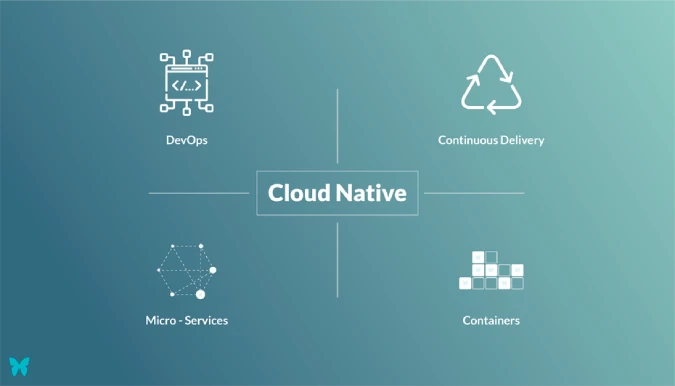
DevOps is a concept of collaboration between software developers and IT teams aimed at delivering a high-quality product. DevOps creates a culture and environment where software creation, testing, and release happen faster, more frequently, and more consistently.
Continuous Delivery is the process of continuously and steadily introducing changes and updates into product development, including through automation. Continuous delivery makes software release reliable and repeatable, and enables organizations to deliver updates to individual software components, features, or even entire products faster.
Microservices are an architectural approach to developing an application as a set of small services. Each service implements a business capability, runs its own process, and communicates via its APIs or messaging. Each microservice can be deployed, upgraded, scaled, and restarted independently of the other services within the same application—typically as part of an automated system—enabling continuous updates to live applications without impacting customers.
Containerization is OS-level virtualization that ensures an application runs with the minimal required resources in a standardized space (a container). Using OS-level virtualization, a single OS instance is dynamically partitioned into multiple isolated containers, each with a unique writable file system and a resource quota. Low overhead for creating and deleting containers, combined with high packing density on a single VM, makes containers an ideal compute vehicle for deploying individual microservices.
De Novo provides the KaaS service for convenient management of Kubernetes clusters directly within De Novo clouds.

Why are Cloud Native applications important?
Cloud Native applications are built and deployed at a very fast pace by small specialist teams on platforms that provide easy scaling and hardware abstraction. This approach gives organizations greater flexibility, resilience, and portability in cloud environments.
-
A strong competitive advantage
Cloud-based development is a shift into a new competitive environment with many convenient tools, no capital expenditures, and the ability to manage resource volumes in minutes. In the software era, companies that can rapidly build and deliver software according to customer needs achieve greater success. -
The ability to focus on resilience
Cloud Native development makes it possible to focus on tools for ensuring fault tolerance. The cloud landscape evolves quickly and helps developers and architects design systems that remain interactive regardless of environment outages. -
Efficiency and flexibility
Cloud systems enable fast and efficient management of the resources needed to build applications. The ability to implement a hybrid—or even multi-cloud—environment allows developers to use different infrastructures to meet business needs. -
Automation and enterprise transformation
Automating an enterprise’s IT function creates a springboard for effectively transforming other departments and teams. It also reduces the risk of failures caused by human error, as employees focus on controlling routine tasks rather than performing them directly. Automated real-time update installation across all stack layers eliminates downtime and the need for experts with “manual operations” experience.
Cloud Native applications vs traditional enterprise applications
| Cloud Native Applications | Traditional Applications |
| Predictability. Cloud Native applications follow a framework or “contracts” designed to maximize resilience to external impacts through predictable behavior. Automated, container-driven infrastructure used in cloud platforms influences how software is written. A good example of such a “contract” is the 12 principles first documented as the 12-factor app. | Unpredictability. Traditional applications cannot always realize all operational benefits due to unique architecture or bespoke development of each individual application. This type of application often takes longer to build, releases updates in large, infrequent batches, and assumes dependent services provide high availability. |
| No OS coupling. Native cloud application architecture allows developers to abstract away core infrastructure dependencies. Instead of configuring, patching, and maintaining operating systems, teams focus on the software. The most effective means of abstraction is a formalized platform. | OS dependence. Traditional application architecture encourages tight coupling between the application and its underlying OS, hardware, storage, and supporting services. Unlike the cloud native model, these dependencies make migration and scaling to new infrastructure complex and risky. |
| Right-sized capacity. Cloud-native platforms automate infrastructure initialization and configuration, dynamically allocating and re-allocating resources during deployment to match application needs. Over time, lifecycle management is optimized, including scaling to demand, resource utilization, orchestration based on available resources, and recovery from failures with minimal downtime. | Need for more capacity. Traditional IT specialists design custom, application-specific infrastructure (“a snowflake”) and postpone deployment. Such solutions are often oversized, built for worst-case throughput forecasts, and have limited ability to scale beyond design constraints as demand grows. |
| Interaction level. Cloud Native architecture strengthens DevOps by improving how people, processes, and tools interact. It increases collaboration between development and operations teams to speed up and smooth the handoff of completed application code into production. | Reduced interaction. Traditional applications rely on handing off completed application code from developers to operations. Organizational priorities outweigh customer value, which leads to internal conflict, slow and compromised delivery, and low team morale. |
| Continuous delivery. IT teams release individual software updates as soon as they are ready. Software-producing organizations quickly get a tighter feedback loop and can respond more effectively to customer needs. Continuous delivery works best alongside related approaches, including test-driven development and continuous integration. | Waterfall development. IT teams release software periodically—often at intervals of weeks or months—despite many components having been ready much earlier and without dependencies. Features customers want or need are delayed, and the business misses opportunities to compete, win customers, and increase revenue. |
| Independence. Microservices architecture breaks applications into small, loosely coupled, independently operating services. These services are developed by small independent developer teams and enable frequent updates, scaling, and resilience/restart without affecting other services. | Dependence. Monolithic architectures combine many disparate services into a single deployment package, creating unnecessary dependencies and reducing flexibility during development and deployment. |
| Fast recovery. Container runtime and the orchestrator provide dynamic, high-density virtualization that is ideal for microservices. Orchestration dynamically manages container placement across the cluster to ensure elastic scaling and recovery/restart in case of application or infrastructure failure. | Slow recovery. Traditional tools are slower and less efficient foundations for microservice applications due to slower start/stop and the OS overhead for each individual VM. |
Use Cloud Native wisely
With a properly designed Cloud Native architecture, your operations teams will be more effective in improving and automating processes, delivering direct business value. But remember: this is only one tool among many, and it brings benefit only when used correctly.

Prioritize workloads for modernization
Not every application needs to be transformed into Cloud Native. Business and IT specialists should work together to prioritize legacy and new workloads and applications in order to determine technical nuances, strategic importance, and ROI in each specific case.
Decide whether to build or buy a platform
Some teams build their own platform using a combination of open-source automation technologies and containers. However, selecting, deploying, and integrating components—when done incorrectly—slows down actual application development, and such a do-it-yourself (DIY) platform requires ongoing maintenance and upgrades. There are tools that provide a complete, ready-made platform and allow teams to focus on building applications directly.
Subscribe to our blog and follow our social media to stay up to date with the latest cloud technology news.